Monday, January 02, 2023

I Secretly Love Global Warming

  In recent weeks I have been thinking a lot about why we as a society are so reluctant to seriously fight to eliminate carbon emissions. I am an environmental voter. I look for and vote for candidates that take environmental science seriously, who appear to understand climate change, and understand that the only real solution is to dramatically cut emissions of green house gasses, and that our carbon economy. As an individual I purchased well insulated housing, use energy efficient heat pump, keep my thermostat at 67 degrees (60 at night) in the winter and wear extra layers. We bought Priuses more than ten years ago, and before that sought out the most fuel efficient cars possible. I recycle, reduce, reuse. Never replace items (including electronics) until they completely give out. As both and individual and a citizen, I try to be environmentally conscious about all my decisions.

But...you knew there was a but coming! But, I love having 60 degree weather the first week in January. I love that our winters here in eastern Kentucky are overall so much warmer and milder than they were twenty-five years ago. Yes, I absolutely know all the reasons why this is problematic. I understand how extremely mild weather in January, creates problems for plant life cycles, and how plant cycles can get out of sync with animal life cycles of hibernation, migration, mating and new generations. But I love it. My nearly 72 year old, arthritic joints love it.

I also know that we are not only getting warmer winters, we are getting hotter summers (which I don't like quite so much). Moreover, we are getting much frequent weather extremes, including the horrific flooding event that devastated eastern Kentucky in July 2022. I know all this. I know that the long term problems are going to be even worse. That the underpinnings of modern agriculture and modern society are threatened by climate change. Yet I still love these mild winters, I find myself cheering when I see that the NOAA three month climate predictions show high chance of warmer than usual weather this Jan/Feb/March. It also shows higher chance of precipitation, but as long as it's not snow...

All this suggests to me that the crusade against climate change has a significant problem, because I can hardly be the only person who intellectually grasps the problems of climate change, yet still on a personal day to day business enjoy its fruits especially in winter time. Which means that there are many of us, regardless of well we understand the problems created by climate change, might balk about making real  sacrifices in the comfort and convenience afforded by a fossil fuel economy that are really needed in order to significantly reduce greenhouse gas emissions. 

Sunday, November 06, 2022

Diamond Painting and the Demise of Society

Recently, I've noticed a new type of video in Facebook's Reels (their ripoff of Tiktok): repetitious images of small, colorful, plastic dots being sucked up by and handheld tool and plunked down, row after row, on an adhesive canvas.   The videos have a hypnotic appeal, especially with the sound effects. Today, having nothing else much to do (except laundry, dishes, bill paying, cleaning up after cats and dogs, and worrying about potential demise of democracy on Tuesday, etc.) I decided to learn more about the activity these videos represent called diamond painting. 
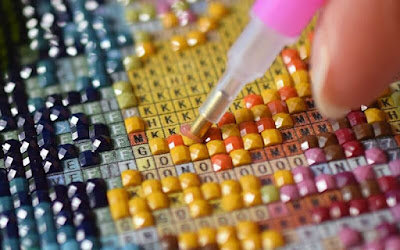

I began by Googling "diamond painting" and discovered that there were a large number of retailers from whom I could order diamond painting kits, but Google didn't hold too many hints about the nature of this activity. So it was off to YouTube. My husband always says if you want to find out how to do something, indeed anything, go to YouTube. I began with a video that was titled "Things I wish I'd know when starting diamond painting." 
The video which was about 12 minutes long was visually an uninterrupted flow of a woman's hands putting red diamonds, one by one, onto a complex, apparently abstract design that was already about one half completed.

The first thing I noticed about this video, and all the others that I watched this afternoon, was that these experienced diamond painters were almost always demonstrating placing the little plastic color chips on their canvas one-by-one, and not in groups of five to ten as shown in the Reels I'd seen on Facebook. Yet even this still had a nice repetitive, hypnotic effect on the viewer. Over this visual a woman with a pleasant voice talked steadily, and easily about the things she wished she'd known which included things like: round vs. square diamonds really didn't matter much, spending money on better tools than those that came with every kit did matter (for example broader sturdier "pens" led to less hand cramping, bigger sorting boxes led to less refills, etc.), the size of the design mattered a lot in terms of detail afforded, and several other points that I forget already. 

I watched at least a dozen different videos (from hundreds that were available on YouTube), produced by five different women. Which leads me to my first observation: diamond painting appears to be primarily a hobby of women. I'm sure there are men who do it, I just didn't see any videos by men in my brief foray into the subject.  I kept coming back to the woman who had produced the first video I saw, because I really enjoyed her voice, and she demonstrated the widest array of types of diamond paintings from quite simple and small, to large canvasses with 277 colors (from a company in Germany). 

My second observation is that diamond painting involves a lot of highly repetitive and actually soothing activity. It seems to be pretty low stress, repetitive, calming, requiring only modest skill levels, hand/eye coordination, and dexterity. I probably couldn't do it because I suffer from essential tremor in my hands and have both severe osteo- and rheumatoid-arthritis in my hands. The companies that produce diamond painting kits market them tout the hobby as restorative, calming, soothing, allows one to let ones mind wander, and still end up with a beautiful product without any artistic talent required. It is being marketed as a type of "art therapy", much the way that adult coloring books were marketed a decade ago. Of course with adult coloring books, the individual got to choose which colors they would use to color in the designs - so that the end product was highly individualized and far more creative than diamond painting. 

Companies selling diamond painting kits describe them as being much like "paint by numbers" kits. However, while paint-by-numbers kits told one where to put which color, the application of the color with an actual paint brush required substantially more skill, and led to much more variation in the final product than diamond painting does. 

So where does "the demise of society" come into this? Let me start by making it clear that there is nothing inherently wrong with engaging in activities that are repetitive, soothing and calming. Running, walking, yoga, meditation, even routine household chores (I find washing dishes soothing and mindless), raking leaves, mowing the lawn, all can have those effects. Although not as repetitive, activities like singing and dancing can also relieve stress and anxiety. However, the fact that there seems to be an ever greater need for activities to reduce stress and anxiety is concerning, and indicative of serious underlying fault lines in our society.   The widening disparity between rich and not just the poor but the "middle class" is just one among many of those fault lines. The on-going commodification of life, where more and more things (education, water, health) have dollar signs attached to them, and become less available to those with low incomes, is a second fault line. The erosion of our environment, with massive shifts in climate is another. 

I'm not trying to trash the individual people who enjoy engaging in diamond painting, it looks like a pleasurable activity and its hard to fault individuals for liking it. However, on a societal scale it represents two disturbing trends: commodification and environmental destruction. It sucks most of the skill and creativity out of an activity, requires substantial expenditure of cash (kits can cost upwards of $75 for large more complex artwork), and dramatically contributes to the very serious problem of plastic pollution, especially pollution by tiny particles of plastic. I learned from one of the videos I watched than depending upon the company one might have to reject or throw away a significant percentage of the diamonds one gets because they are flawed in some way. Also, the storage of diamonds involves the use of plastic containers (from very small to quite large). Then there is the long term future of all the art work produced covered as it is with all these tiny plastic chips. None of these are heirloom products, they won't be sold, collected, put in museums or even cherished by younger generations. They will ultimately from a few months to a few decades, end up in the trash. At a time when our oceans are being overcome by micro-plastic pollution, that is ending up inside wildlife and even humans. 


Sunday, February 20, 2022

Return to Zombie America

image from Umair Haque's article
on the American Collapse
Outstanding article "Why We are Underestimating American Collapse" by Umair Haque in Eudaimonia  looks at some of the human costs such as the epidemic of school shootings, the "opioid epidemic," the declining life expectancy of rural, white Americans.

This all fits in with what I've started calling  "zombie America." Zombies are variously referred to as the "undead" and the "walking dead," phrases that I think can be applied to American economy, politics and society at large. The nation is still lurching and weaving about, animated but no longer truly alive, dead (or dying) on the inside but because still animated, so that many observers still imagine it to have life.

Not like science fiction: the decline of America

 I began reading science fiction when I was nine, and it remains even today sixty-two years later still my favorite flavor of fiction, but science fiction has taught us all to expect the end of civilization to come abruptly, dramatically and unmistakably. This has made us collectively blind to the real world slow, drip-drip erosion of our society. 

A good example of what I'm talking about is the novel (and now HBO series) Station Eleven, a story of an apocalyptic pandemic and its aftermath. The novel published in 2014, shows the disease a deadly "flu" killing something like 90 percent of the people infected, and its impact in disrupting society occurs within days. People die in the streets, in their cars, everywhere all at once, and almost instantly modern society as we know it is gone.  Some time in the last month or so, I ran across someone (on Twitter or in an interview) using Station Eleven as the rubric against which our real world COVID pandemic should be marked as not very serious. I wish I'd written it down, saved the Tweet or bookmarked the interview because it epitomizes the way we've ingrained science fiction as the arbitrator of what is and what is not the end of the world.

Make no mistake about it, we are already in the midst of the fall and decline of the great American democratic, post-industrial society. It has been going on for some time now, at least two decades, but probably longer than that. Let me make it clear, I am NOT a MAGA, I am not talking about trying to recover some fake golden age of the past. I see as good and positive trends the exact things that MAGA people hate: increasing diversity, greater political, social and economic power for women and people of color, increasing openness to alternatives to rigid gender boundaries and the celebration of all kinds of sexual orientations. I applaud marriage equality and support the Black Lives Matter movement. 

However, even if the MAGA crowd is wrong about what ails our society and who or what is responsible, they are on to something when they express anxiety about the decline of America. Extreme inequality in wealth, political power, and social opportunities are fundamentally distorting and destroying our society. A very small class of people benefit hugely, others benefit slightly and the vast majority find themselves living on the edge with little voice and less influence. 

The COVID pandemic did not cause any of this, but it exacerbates all the existing problems, continues tiny piece by tiny piece to help tear away at the fabric of society. The pandemic which has killed less than one percent of our population has nonetheless shredded our health care system, scratches at our supply lines, and creates a huge new class of disabled persons, and is far from over in terms of its impacts, regardless of our intentions to just "live with it." 

Monday, September 28, 2020

This Election Is Like No Other

There have been many signs that this election of 2020 is different from any election in my lifetime. Certainly there have been plenty of pundits in newspapers and on cable news shows telling us all that this is different, that people's vote matters more this year than ever before. 

But now I have irrefutable evidence that this is so, because my friend Debby made a political post on Facebook. While it is true that all she did was share an opinion piece by Dan Rather that outlined why "This is a battle for American democracy as we've known it," this is the first time in twelve years on Facebook that I've ever seen Debby make any kind of political post. In fact, in the more than 40 years that we've been friends I don't think I've ever heard Debby say anything political ever. Debby's Facebook page is almost exclusively dedicated to her family (parents, siblings, husband, adult children, grandchildren, dogs, cats, hamsters, etc.) and to her favorite cause: getting parents to read to their children. And I love her for this. You don't know someone as well as I've known Debby for forty years and not be pretty sure about their values and where they might fall on the political spectrum. But this is the first time I've ever seen her take a stand, clearly alienates her from some of the other friends on her "friends list". 

The thing is that Debby's not my only long time friend to suddenly emerge this September after a life time of keeping their political views quiet and become vocal about the dangers of a second term for Donald Trump. I live (as does Debby) in a geographic region considered "Trump country" and over the past month I've been surprised at how many of my previously quiet friends have started speaking out, and courageously (and courteously) standing up to their many friends and family members about this election. This vocal turn by a growing number of my previously "apolitical" friends, declaring that this election is different, that this current president is a threat to the America that they hold dear, tells me far more than any mass media pundit or celebrity that this really is an election like no other. 

Tuesday, August 11, 2020

The United States Postal Service as a Symbol of the Nation

In 1985 scientist and science fiction writer David Brin published a post-apocalyptic novel entitled The Postman. If you are not a reader of science fiction you might be more likely to remember the movie directed and starred in by Kevin Costner in 1997. During the early weeks of the pandemic shutdown back in April, when Trump first started making noises about undermining the U. S. Postal Service, I decided to re-read the book. 

The key idea of The Postman is that the United States Postal Service is more than simply a service to deliver mail and packages, it is a powerful symbol of our united nation. So much so that in a fragmented post-apocalyptic world,  men wearing the uniform of the USPS and carrying mail from community to community can be enough to jump start the economic, social and political unification of a country. 

The U. S. Postal Service provides enormous practical benefit to Americans regardless of their economic or social standing. In fact the lower your economic and social status is the more you may benefit from the USPS. Every address and community, no matter how small or rural must be served by the USPS.  If you don't get home delivery and can't afford a post office box you can still get your mail general delivery at your local post office. We may not be big senders of cards and letters in this age of digital communications, but we still do business by mail, pay bills by mail, get checks by mail, get medications by mail. 

However, the real point here is that far above and beyond the practical benefits of the U. S. Postal Service is the symbolic role it plays in our sense of all being citizens in one nation.  There are several examples that highlight this. One is the degree to which Americans have mythologized the Pony Express, a service that lasted a mere 18 months (April 3, 1860, to October 24, 1861), that tied the eastern United States to the relatively new state of California.  For something that lasted such a very short time, the Pony Express lives in the American psyche as the epitome of nationhood - physically linking states together across a wilderness. Another is the beloved Christmas movie Miracle on 34th Street in which the U. S. Postal Service delivers bags and bags of mail addressed to Santa Claus to Kris Kringle in the court room. If the mighty U. S. Postal service, an official government agency  could recognize Kris Kringle as Santa Claus, then that was enough for the judge. 

All those people salivating with dollar signs in their eyes, over the prospect of carving up the business of the Post Office and distributing it to for-profit corporations, miss this very important fact about the U. S. Postal Service. It is far more than a set of services, it is part of the fabric of America, and it is a symbol of our national unity. 

If we lose the United States Postal Service we lose our national soul. 

Monday, January 14, 2019

What Trump Really Wants is to "Militarize" the Border

For the past three years, liberals and other opponents of Trump, have been ridiculing the idea of the border wall as an unnecessary, nonsensical, boondoggle. This ridicule has increased in the last month as "The Wall" has become the basis for government shutdown (currently in its 24 day - January 15, 2019). There has been a proliferation of memes and cartoons about ladders and stairs, as opponents try to point out the senselessness of a physical border, especially out in barren, desert and deserted areas of the border, when human ingenuity is easily capable of circumventing any humanly designed barrier. Opponents tried to show that it was a pointless exercise.

Turns out we, the opponents of the wall, were the ones that just weren't getting the point. We didn't get that Trump and his supporters never were talking about a physical barrier sitting out in the open by itself. They were always talking about a defended border, a "militarized" border, a border with guard towers, spotlights, and machine guns. A border where those who attempted to cross the barrier would be shot.

How in the f*k did I not grasp this before? This isn't about a wall, the wall is just the the first, necessary step, the place for soldiers to stand, a place for the machine gun turrets. He and his supporters want a 2-thousand mile "Berlin Wall" or Korean DMZ.


https://twitter.com/realDonaldTrump/status/1084650944846012417

That's what it has always been about, a militarized border, with guard towers and search lights, and automatic weapons, where soldiers patrol,  and shoot to kill anyone who dares cross the line.

This wall is not just a pointless, ineffectual waste of money, its the first step in turning our country into an armed camp.

We must say "No!" to this, because if we give in, it will never stop.